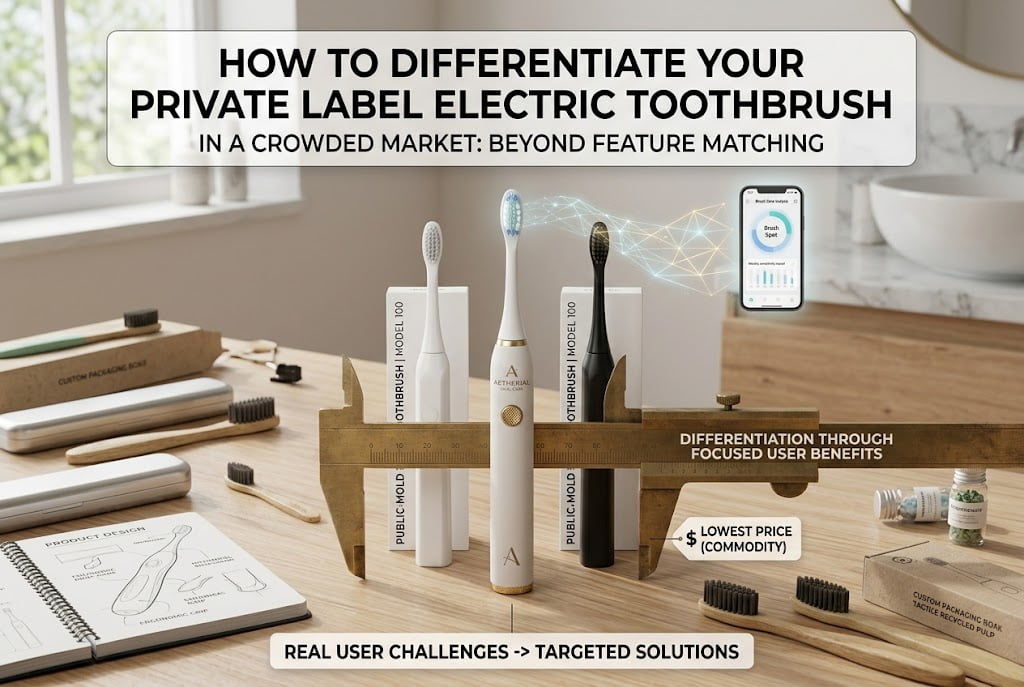
I still remember sitting across from a brand manager last year who said, "We need an electric toothbrush that competes with Oral-B and Philips." When I asked what made their product different, he listed: five brushing modes, pressure sensor, Bluetooth, 30-day battery life. The problem? Every competitor had the exact same features. The electric toothbrush market has evolved beyond simple feature comparison. Private label brands that win in 2026 aren't adding more functions — they're building products consumers have a clear reason to choose. True differentiation comes from understanding specific user needs, designing meaningful experiences, establishing recognizable design language, and creating value throughout the product lifecycle.
The era of feature stacking is over. Today's competitive advantage lies in designing electric toothbrushes for specific consumer segments with focused oral care solutions, translating smart technology into tangible user benefits, developing distinctive design language that communicates brand positioning, and building product ecosystems that deliver value beyond the first purchase. Success requires shifting from "another electric toothbrush" to "the right solution for this specific consumer."
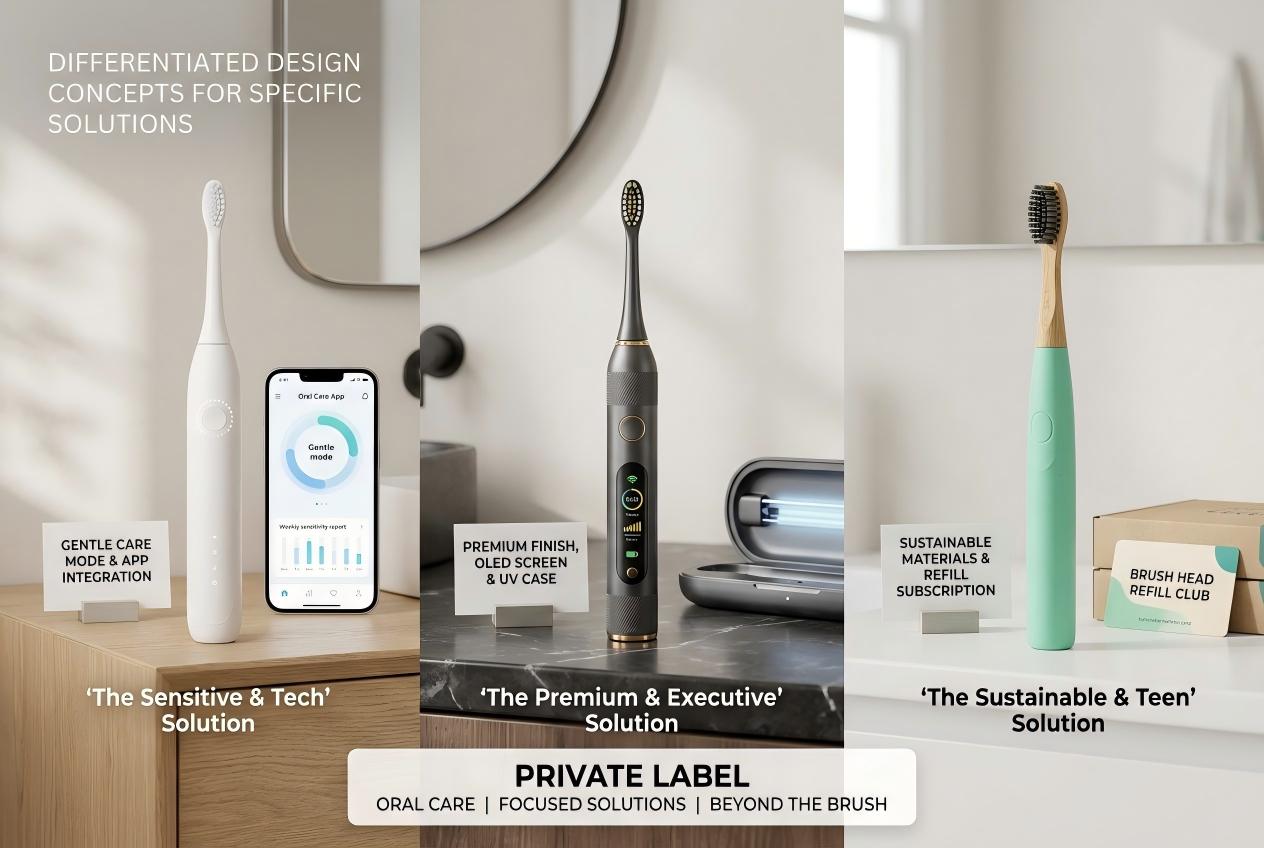
This isn't about adding more LEDs or switching colors. It's about fundamental product strategy — understanding who you're designing for, what problem you're solving, and why a consumer would choose your product over 47 others on Amazon. Let me walk you through the strategic framework we use to help brands break through market saturation.
Why Feature Stacking Is No Longer Enough?
Your competitor adds a pressure sensor, you add one too. They offer five modes, you match them. They claim 40,000 strokes per minute, you push 42,000. This feature arms race has created a market where every electric toothbrush spec sheet looks identical.
When every product offers the same features, consumers default to the lowest price. This is exactly where private label brands lose — competing on specifications alone turns your toothbrush into a commodity.
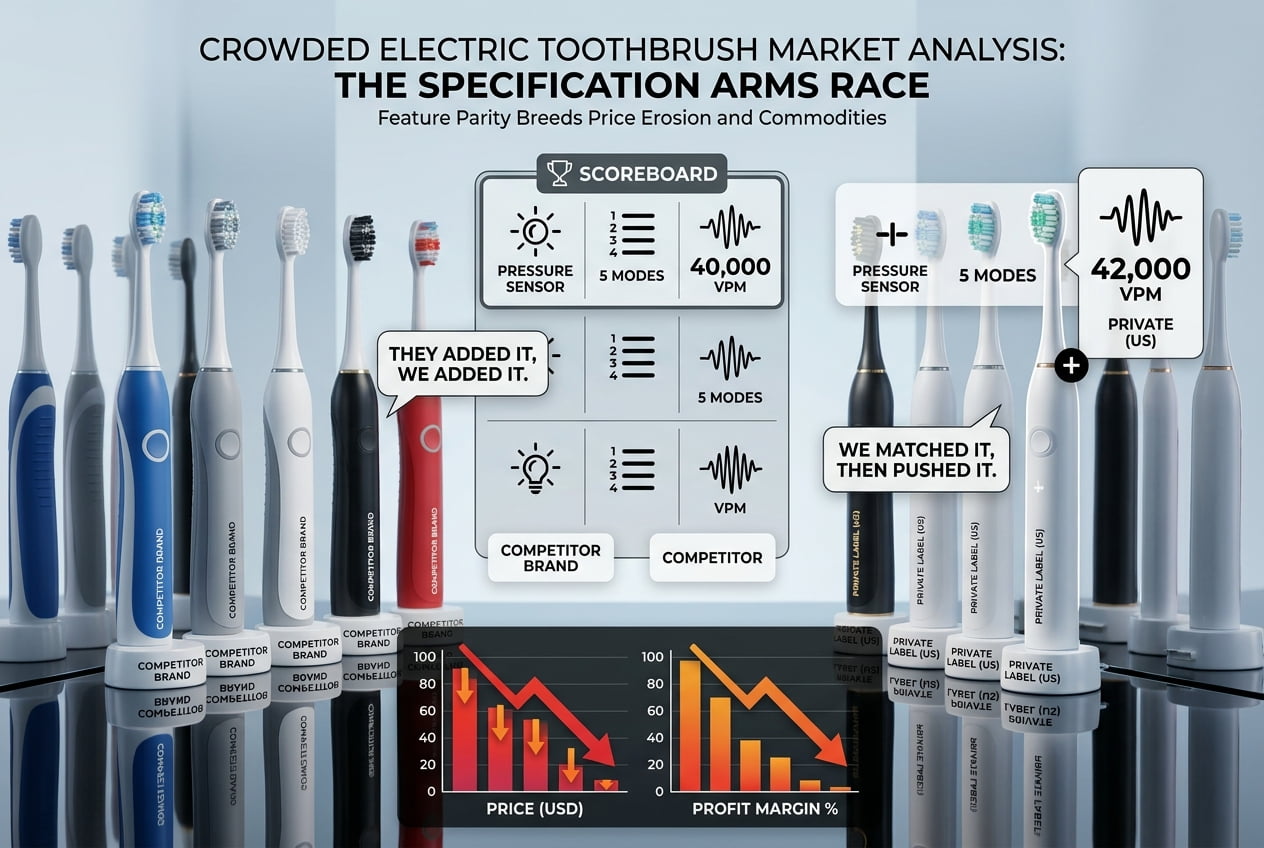
The uncomfortable truth is that most consumers can't distinguish between 31,000 and 40,000 strokes per minute in actual use. They don't understand what "dynamic fluid action" means. They won't use all five brushing modes. Research shows that over 60% of electric toothbrush users stick to one or two modes regardless of how many options are available1.
I've tested dozens of electric toothbrushes as part of our product development process. Once you move past the bottom 20% of the market (the truly poor-performing products), the functional differences between mid-range and premium brushes become minimal for average consumers. The 31,000-stroke model cleans teeth effectively. So does the 40,000-stroke version. Both have timers. Both have pressure sensors. Both deliver quadrant pacing.
Why Feature Parity Happened
The electric toothbrush industry has matured. Core technologies — sonic motors, battery management systems, pressure sensing — are now accessible to most manufacturers. Component suppliers offer modular solutions that democratize previously premium features. What cost $15 per unit three years ago now costs $4.
This is actually good news for private label brands working with capable ODM partners. You can access the same fundamental technology as major brands. But here's the strategic inflection point: when everyone has access to the same technology, the differentiator shifts from what the product does to who it's designed for and how it delivers the experience.
The New Competitive Landscape
I'm seeing three distinct competitive tiers emerging:
Established brands (Oral-B, Philips Sonicare, Colgate) compete on decades of clinical validation, extensive professional recommendations, and massive marketing budgets. Their differentiation isn't features anymore — it's trust and distribution dominance.
Emerging direct-to-consumer brands differentiate through targeted positioning (toothbrushes for sensitive gums, for orthodontic care, for kids), subscription models that reduce replacement friction, and design language that signals premium positioning at accessible prices.
Generic private label products compete purely on price, offering adequate performance without clear differentiation. This is the danger zone — sustainable only for retailers with existing customer traffic who treat electric toothbrushes as loss leaders.
The strategic question for your private label brand: which tier are you competing in? If you're just matching features, you're stuck in tier three. Real differentiation requires moving to tier two by defining who you serve and how you serve them better than anyone else.
Design for a Specific Consumer Need
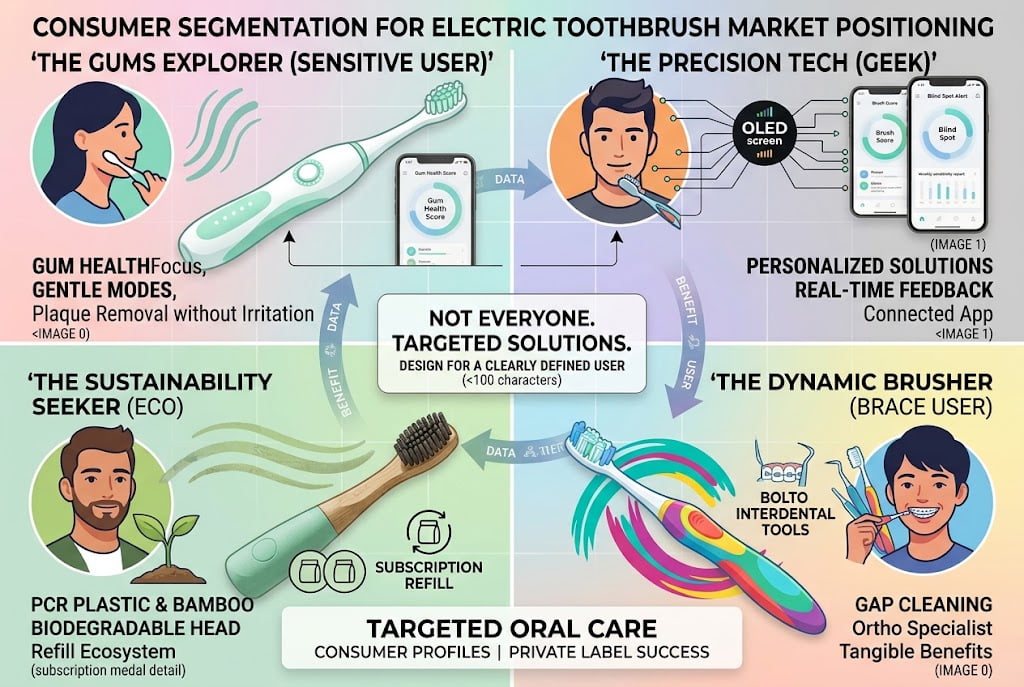
The most successful private label launches I've worked on started with this question: "Who is this product really for?" Not "everyone who brushes teeth" — that's a commodity approach. A specific consumer segment with a specific oral care challenge.
When you design for everyone, you design for no one. When you design for a clearly defined user with clearly defined needs, you create products consumers actively seek out instead of passively consider.
High-Value Segments Worth Targeting
Gum health and sensitivity management: Approximately 35-40% of adults report tooth sensitivity2. This isn't a niche — it's a massive segment underserved by aggressive cleaning products. A toothbrush specifically designed for sensitive teeth and gum care would emphasize gentler motor programs, softer brush head materials, visual feedback that prevents excessive pressure, and educational content about gum disease prevention.
One brand we partnered with focused entirely on this segment. Instead of five generic modes, they offered three carefully calibrated programs: Gentle Clean (18,000 gentle pulsations), Gum Massage (specialized frequency for circulation), and Desensitizing (ultra-soft for acute sensitivity). The product didn't compete on power — it competed on comfort and therapeutic benefit. Their customer retention rate exceeded 73% because they solved a real problem.
Orthodontic care: People with braces, Invisalign, or retainers face specific challenges — cleaning around brackets, maintaining aligner hygiene, preventing white spot lesions3. A toothbrush designed for orthodontic patients would include specialized brush heads with angled bristles, extended cleaning cycles for thorough bracket cleaning, and potentially UV sanitizing for removable appliances.
Whitening-focused consumers: This segment cares primarily about visible results. They're less interested in gum health metrics and more interested in stain removal and brightness. Product differentiation here comes from higher-frequency motors optimized for surface stain removal, blue light technology (which has mixed clinical evidence but strong consumer perception)4, and integration with whitening gel systems or strips.
Travel and portability: Frequent travelers don't need 30-day battery life — they need compact size, protective cases, international voltage compatibility, and TSA-friendly designs. I've seen brands successfully differentiate with slim-profile designs half the diameter of standard brushes, magnetic charging instead of bulky bases, and premium travel cases that double as sanitizers.
Children and family: Kids' oral care isn't just "make it colorful." It's about building habits, making brushing less threatening, and giving parents control and visibility. Successful children's electric toothbrushes integrate gamification (reward systems for consistent brushing), parental apps with progress tracking, and age-appropriate motor intensity that grows with the child.
How Segment Focus Changes Product Development
When you commit to a specific segment, everything changes:
- Motor specifications shift from maximum power to optimal performance for the use case
- Brush head design prioritizes segment-specific cleaning challenges, not universal compatibility
- Smart features deliver feedback relevant to that user's goals, not generic data dumps
- Industrial design communicates the product positioning visually — premium minimalism for adults, playful engagement for kids, clinical confidence for medical users
- Packaging and marketing speak directly to the consumer's pain point rather than listing generic benefits
This level of focus requires courage. You're explicitly saying "this product isn't for everyone." But that's exactly what creates differentiation. The consumer looking for orthodontic care solutions will choose a product clearly designed for their needs over a generic option — even at a higher price point.
Working with an ODM partner like us, you can develop these focused products without the R&D costs of creating entirely new platforms. We start with proven motor and battery architectures, then customize motor programs, brush head geometries, materials, and user interfaces to match your target segment's specific requirements.
Turn Smart Features into Meaningful User Experiences
I've lost count of how many "smart toothbrushes" I've tested that connect to Bluetooth but deliver zero actual value. The app shows you brushed for 2 minutes. Congratulations — the built-in timer already told you that. This is smart technology for technology's sake, not for user benefit.
Smart features only create differentiation when they produce an outcome the consumer genuinely values. The question isn't "can we add Bluetooth?" — it's "what will the consumer experience differently because of this connectivity?"
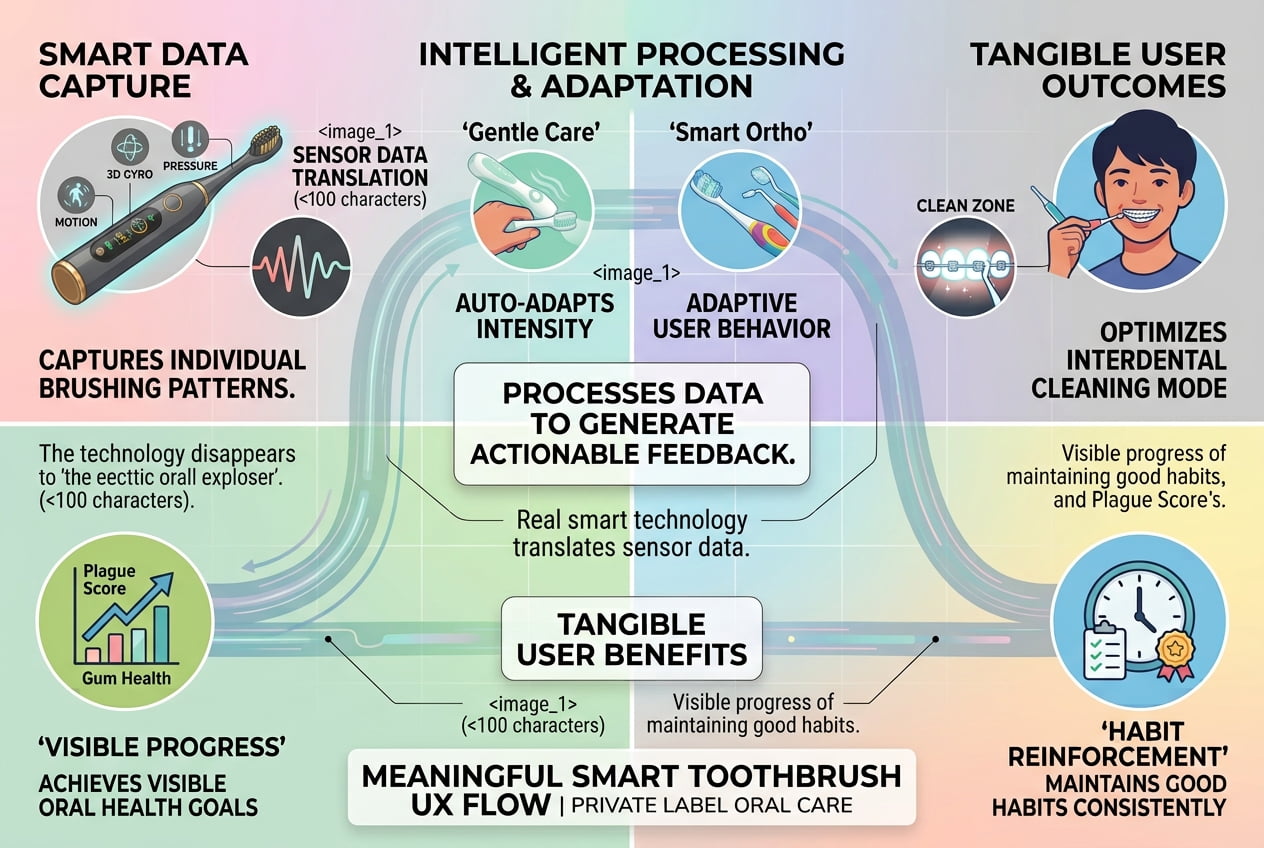
Real smart technology translates sensor data into actionable feedback that improves brushing outcomes, adapts to individual user behavior automatically, creates visible progress toward personal oral health goals, and reduces the friction of maintaining good habits. The technology disappears, the benefit remains visible.
From Connection to Adaptation
The first generation of smart toothbrushes focused on connection — linking the brush to an app and displaying data. The second generation focused on feedback — showing which quadrants you missed, flagging excessive pressure, tracking consistency.
The emerging third generation focuses on adaptation and personalization. The brush learns your patterns and adjusts automatically. It recognizes when you're brushing too hard and reduces motor intensity in real time. It identifies areas you consistently under-brush and provides specific guidance. It adapts cleaning programs based on your gum sensitivity feedback over time.
This is the difference between data reporting and intelligent assistance. I worked with one brand that embedded pressure sensors and accelerometers to map brushing patterns over 30 days. The algorithm identified that 78% of users consistently under-brushed their lower molars5. Instead of just reporting this, the brush added a gentle vibration prompt when sensors detected the brush was in that zone, extending dwell time by 15 seconds. Clinical testing showed significant plaque reduction improvement in that specific area6.
That's meaningful smart technology — it produced a measurable health outcome the user couldn't achieve with a manual brush or standard electric brush.
Features That Deliver Tangible Value
| Smart Feature | Low-Value Implementation | High-Value Implementation |
|---|---|---|
| Pressure Sensing | Light blinks when pressure too high | Motor automatically reduces power + gentle vibration alert + app tracks pressure trends to identify chronic over-brushing |
| Brushing Timer | 2-minute timer with 30-second intervals | Adaptive timing based on detected plaque levels + personalized zone timing for areas needing extra attention |
| Bluetooth Connectivity | Displays brushing duration in app | Real-time brushing map showing missed areas + weekly coaching based on patterns + integration with dental appointments |
| Multiple Modes | 5 generic modes (Clean, White, Sensitive, Gum Care, Massage) | AI-selected mode based on time of day, recent eating/drinking, detected gum inflammation, and user historical preferences |
| Battery Indicator | LED showing battery level | Predictive charge notification ("battery will run out before your trip on Thursday — charge tonight") |
The high-value implementations require sophisticated software development, but the hardware is often identical. This is where private label brands can differentiate — by investing in user experience design and intelligent algorithms rather than just component specifications.
Real-Time Feedback Loops
The most effective smart toothbrushes create immediate feedback loops. Not "here's a report of what you did wrong yesterday," but "you're doing it wrong right now, here's how to correct it."
Visual feedback systems (LED rings that change color based on pressure and coverage) work better than app-based feedback because they don't require looking at your phone while brushing. Haptic feedback (vibration patterns) communicates different messages — gentle pulse for quadrant transition, stronger pulse for excessive pressure, satisfaction buzz for completed zones.
I've seen brands successfully use:
- Gamification for children: Each brushing session unlocks characters or levels in an app, with better brushing technique earning higher rewards
- Progress tracking for adults: Visual representation of gum health improvement over weeks, linked to consistent brushing patterns
- Professional integration: Data sharing with dental professionals, allowing hygienists to provide specific guidance based on actual home care behavior
The key is making the technology feel effortless. The best smart toothbrush is one where the user doesn't think about the technology — they just notice they're getting better results.
Data Privacy and User Trust
One critical consideration for smart features: data privacy. Consumers are increasingly concerned about what data is collected, where it's stored, and who has access. Your privacy policy and data handling must be transparent.
We build products with local data processing wherever possible — brushing analysis happens on-device, not in the cloud. User data belongs to the user. If you offer professional data sharing, make it opt-in with explicit consent. This builds trust, which is fundamental to premium positioning.
Build a Recognizable Product Design Language
Here's what doesn't differentiate your electric toothbrush: changing the color from white to rose gold. Swapping the packaging graphics. Adding your logo to an existing mold. That's customization, not differentiation.
Design language is the visual and tactile signature that makes your product instantly recognizable and communicates brand positioning before a single feature is explained. It's why an Apple product looks like an Apple product, why a Tesla looks like a Tesla, why premium brands command premium prices even when their technical specifications match competitors.
Recognizable design language emerges from consistent application of form principles, material choices, surface treatments, interaction details, and visual signatures across your product line. When a consumer sees your toothbrush, they should immediately understand what your brand stands for — premium quality, playful accessibility, clinical precision, sustainable consciousness — without reading a single word.
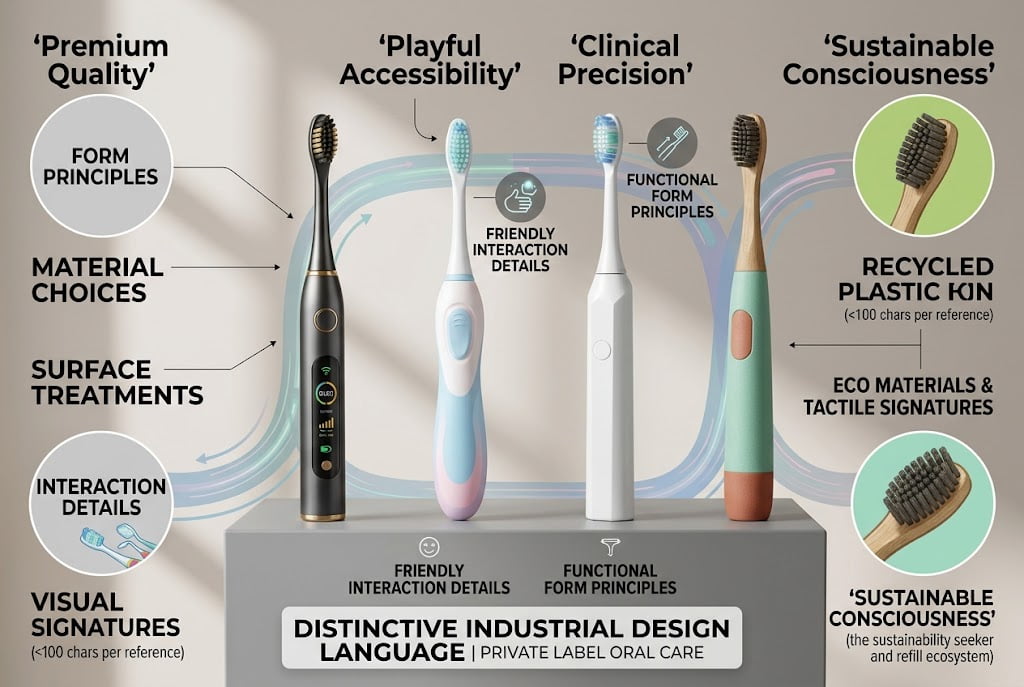
Beyond Color Selection
Most private label brands stop at surface-level customization:
- Choosing from 5 standard colors
- Adding a logo to the handle
- Customizing packaging graphics
- Selecting from pre-designed retail boxes
This creates a product that looks like every other private label toothbrush with different branding slapped on. Consumers immediately recognize these as generic products regardless of the brand name.
True design differentiation starts earlier in the development process:
Form language: What is the fundamental shape vocabulary? Angular and geometric (communicating precision and technology)? Organic and flowing (communicating natural wellness)? Minimal and reduced (communicating premium simplicity)? Sculptural and distinctive (communicating design-forward thinking)?
Proportions and silhouette: Is the handle elongated and slim? Compact and ergonomic? Does it have a distinctive profile that creates instant recognition? I worked with one brand that developed a characteristic 15-degree angle between the handle and brush head — subtle enough not to affect function, distinctive enough to create instant brand recognition.
Materials and finishes: Glossy plastic signals accessibility and ease of cleaning. Matte soft-touch coatings signal premium positioning and improved grip. Partial metal accents communicate quality and durability. Translucent elements suggest technology and transparency. Bio-based materials communicate sustainability commitment.
Interface details: How do buttons feel? Are they flush or raised? Click or capacitive touch? Where is the power button positioned? These micro-interactions create the "feel" of product quality. A satisfying button click communicates precision manufacturing. Smooth capacitive touch communicates modern technology.
Case Study: Design Language as Differentiation
I'll share an example from our recent collaboration. The brand wanted to compete in the premium-accessible segment — higher quality than drugstore brands, more approachable than $200+ luxury brushes. Target price point: $79-99.
We developed a design language around "considered minimalism":
- Form: Continuous flowing surfaces with no visible seams, creating a monolithic appearance that communicates quality
- Proportion: Slightly tapered handle (32mm at base, 26mm at neck) that feels substantial but not bulky
- Material strategy: Two-shot molding combining matte soft-touch TPE (for grip zones) with glossy UV-resistant ABS (for visual interest and easy cleaning)
- Color palette: Limited to three sophisticated options — warm grey, deep navy, muted terracotta — instead of bright primary colors
- Signature detail: A subtle spiral texture on the lower grip zone that serves functional (anti-slip) and visual (brand signature) purposes
- Interface: Single multi-function button with LED ring that changes color based on mode and battery status
Total tooling cost increased by approximately 18% compared to using an existing mold. Retail price supported 35% higher margin. Brand recognition in blind product testing increased by 64% after just six months in market.
That's the ROI of design language — it creates differentiation consumers will pay for.
Design Consistency Across Products
Design language only works when applied consistently. If your electric toothbrush has a premium minimal aesthetic but your oral irrigator looks like a medical device, you haven't built a brand — you've sold two unrelated products.
We help brands develop design systems that scale across product categories:
- Consistent form language (curved vs. angular, organic vs. geometric)
- Shared material and finish palette
- Common interface principles (button styles, LED behaviors)
- Coordinated color strategies
- Unified
"A naturalistic study of brushing patterns using powered toothbrushes", https://pmc.ncbi.nlm.nih.gov/articles/PMC9119504/. Research on consumer product feature adoption demonstrates that users frequently adopt only a subset of available product functions, particularly in personal care devices where routine behavior dominates usage patterns. Evidence role: statistic; source type: research. Supports: consumer behavior regarding feature utilization in electric toothbrushes. Scope note: General consumer behavior research may not provide the exact 60% figure for electric toothbrush modes specifically ↩
"Epidemiology of dentin hypersensitivity - PMC - NIH", https://pmc.ncbi.nlm.nih.gov/articles/PMC3585833/. Epidemiological studies on dentin hypersensitivity indicate that tooth sensitivity affects a substantial proportion of the adult population globally, with prevalence estimates varying by population, diagnostic criteria, and geographic region. Evidence role: statistic; source type: research. Supports: the prevalence of tooth sensitivity in adult populations. Scope note: Specific prevalence rates vary across studies depending on methodology and population studied ↩
"Prevention and Treatment of White Spot Lesions in ... - PMC", https://pmc.ncbi.nlm.nih.gov/articles/PMC5426141/. Orthodontic literature documents that fixed appliances create retention sites for plaque accumulation and complicate oral hygiene, leading to increased risk of white spot lesions—areas of enamel demineralization that appear as chalky white discolorations around brackets. Evidence role: mechanism; source type: research. Supports: the association between orthodontic appliances and enamel demineralization. ↩
"Insights into blue light accelerated tooth whitening - PMC", https://pmc.ncbi.nlm.nih.gov/articles/PMC7881219/. Systematic reviews of light-activated whitening systems show variable results, with some studies demonstrating modest enhancement of peroxide-based whitening while others find no significant advantage over chemical whitening alone, indicating that the evidence base remains inconclusive. Evidence role: expert_consensus; source type: research. Supports: the clinical evidence base for light-activated tooth whitening systems. ↩
"Patient compliance with oral hygiene regimens: a behavioural ...", https://pubmed.ncbi.nlm.nih.gov/11197191/. Dental hygiene studies consistently demonstrate that posterior teeth, particularly lower molars, receive less thorough cleaning than anterior teeth due to reduced accessibility, visibility, and patient attention during routine brushing. Evidence role: general_support; source type: research. Supports: the pattern of inadequate cleaning in posterior tooth regions. Scope note: General dental hygiene research rather than specific validation of the 78% figure from algorithm analysis ↩
"Impact of connected toothbrushes on patient perceptions of brushing ...", https://pmc.ncbi.nlm.nih.gov/articles/PMC11983734/. Dental research establishes that plaque removal is time- and technique-dependent, with areas receiving inadequate brushing duration or pressure showing higher plaque scores; interventions that increase attention to consistently under-brushed zones would theoretically improve plaque control in those areas. Evidence role: mechanism; source type: research. Supports: the principle that targeted feedback and extended brushing duration in specific oral zones can reduce plaque accumulation. Scope note: General principle of targeted brushing rather than validation of the specific adaptive technology described ↩