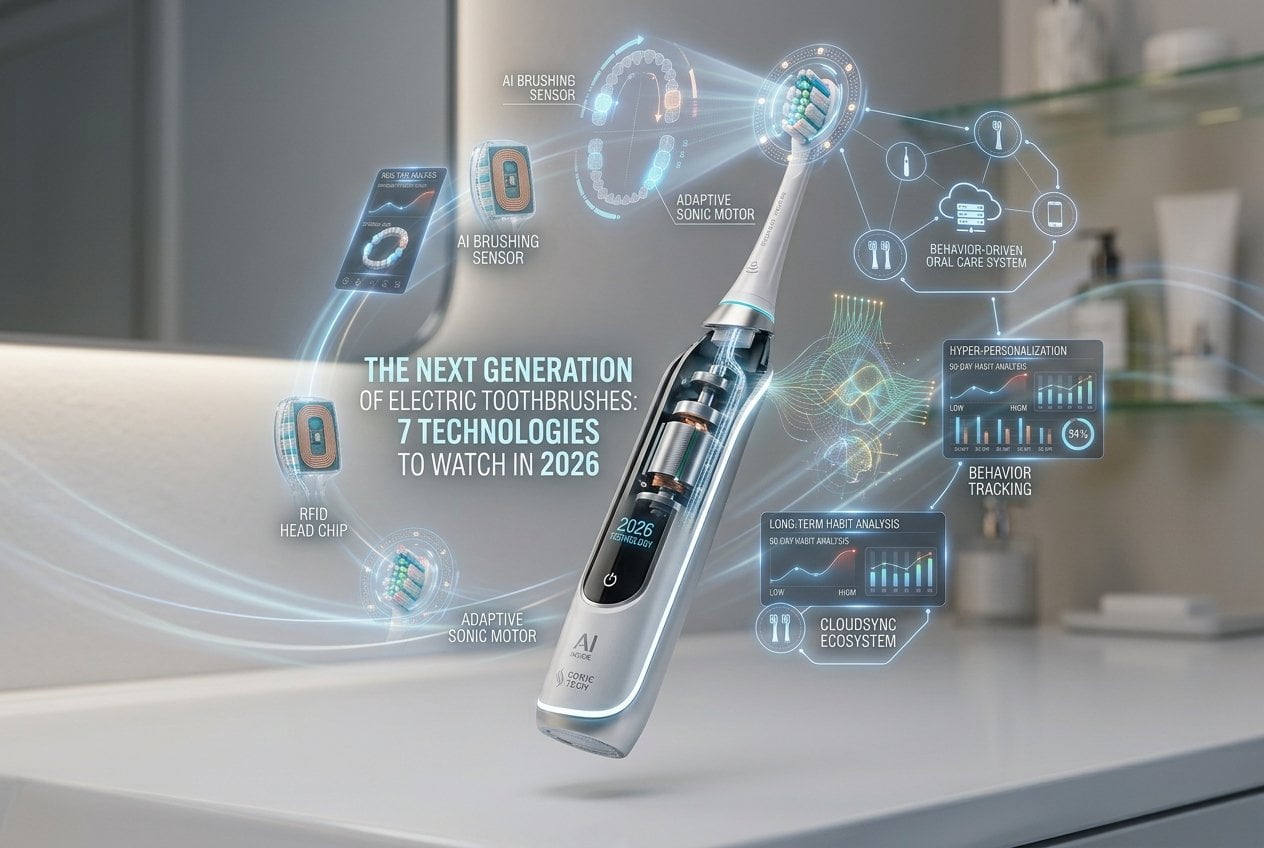
The electric toothbrush market is shifting from hardware specs to behavioral intelligence. For years, brands competed on vibration frequency, battery life, and the number of cleaning modes. But I've noticed something different in recent industry developments — the focus is moving from "more powerful" to "more adaptive." The next generation of electric toothbrushes won't just vibrate faster; they'll understand how you brush and adjust in real time.
The real transformation isn't happening in higher RPM motors or longer battery life — it's happening in how sonic technology, AI sensors, and personalization algorithms work together. By 2026, the best electric toothbrushes won't ask users to choose from eight modes. Instead, they'll automatically adapt cleaning intensity, track brushing behavior without requiring an app, and deliver real-time guidance through smarter on-device intelligence. This shift redefines what "next generation" actually means in oral care technology.
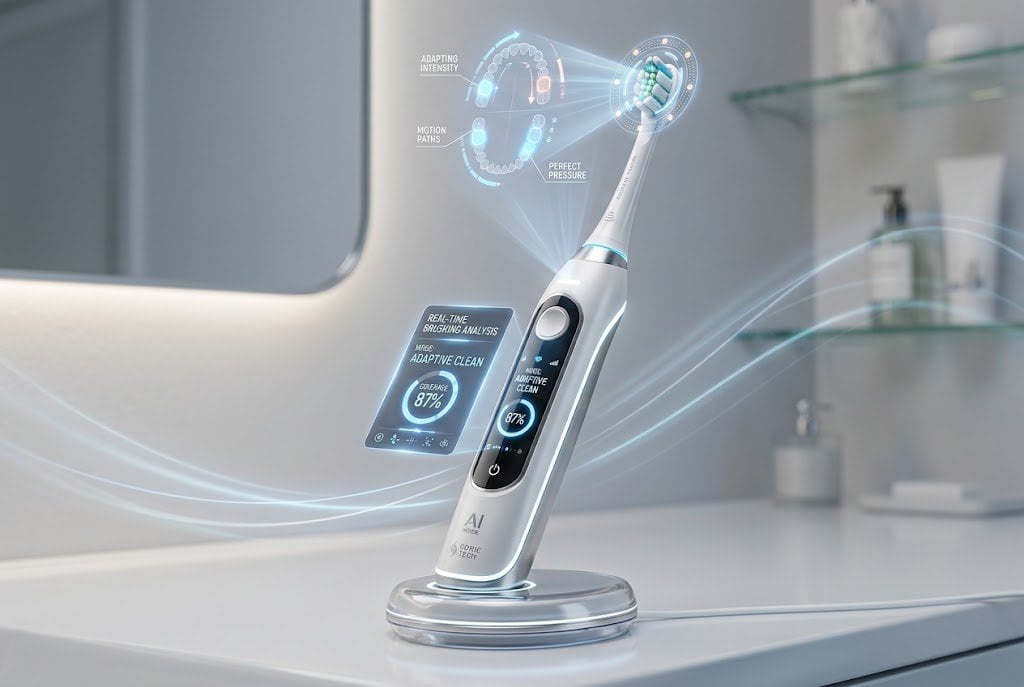
This matters not just for end users but for brands, product developers, and OEM/ODM teams evaluating where the industry is headed. The following sections break down seven key technological shifts — not as isolated features, but as interconnected changes shaping the oral care landscape through 2026.
From More Power to Adaptive Cleaning: How Sonic Technology Is Evolving?
Electric toothbrush marketing has long centered on vibration frequency — 30,000 strokes per minute, 40,000, even higher. But I've started to see diminishing returns in these numbers. More vibrations don't automatically mean better cleaning, and pushing frequency higher can increase noise, reduce motor lifespan, and make brushing uncomfortable for sensitive gums.
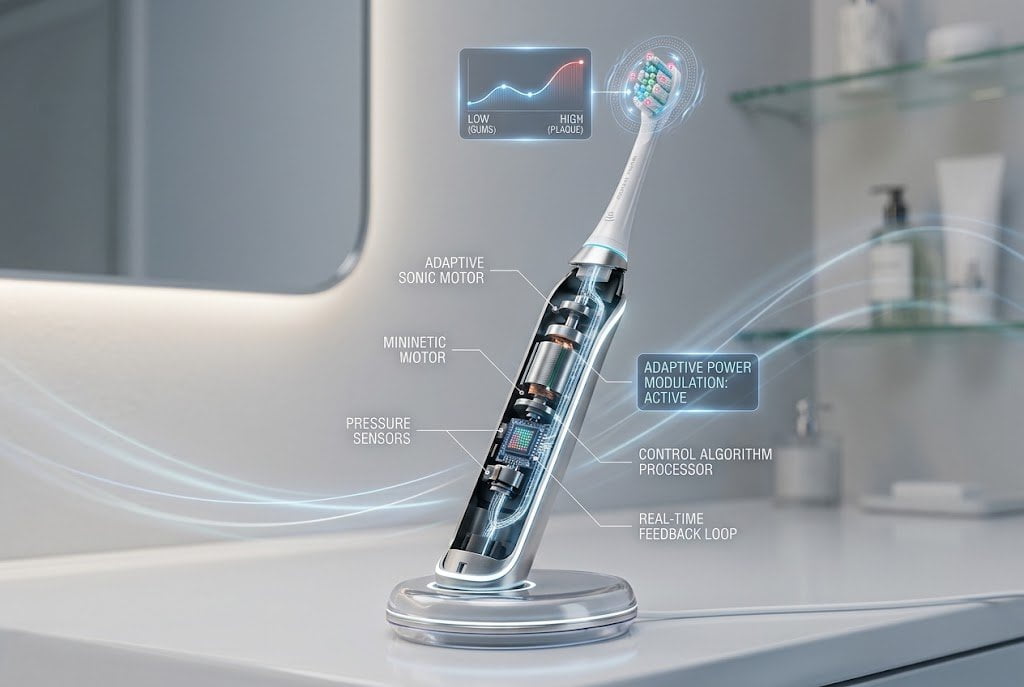
The next phase of sonic technology isn't about adding more vibrations per minute — it's about delivering power more intelligently. Advanced electric toothbrushes in 2026 will use motor control algorithms, pressure sensors, and real-time feedback loops to modulate cleaning intensity based on what the user actually needs in that moment.
Servo-Driven Motors and Dynamic Output
Traditional sonic toothbrushes operate at a fixed frequency regardless of how you hold the brush or where you're cleaning. Dual-action servo-driven motors represent a technical evolution: they combine oscillation and vibration, adjusting power output dynamically rather than running at constant speed.
For procurement teams and product developers, this shift has clear implications:
- Motor consistency under different loads (wet vs. dry brushing, light vs. firm pressure)
- Energy efficiency — smarter motors can extend battery life without increasing capacity
- Acoustic performance — adaptive output reduces unnecessary noise during lighter cleaning phases
In our manufacturing experience, integrating servo-driven control increases complexity in motor tuning and calibration, but it fundamentally changes how the product feels during use. A brush that adapts to gum sensitivity or plaque buildup delivers a better user experience than one that simply vibrates harder.
From Fixed Modes to Continuous Adjustment
I've tested toothbrushes with five, eight, even ten cleaning modes. But most users stick to one or two. The real innovation isn't more modes — it's eliminating the need for users to manually select modes by letting the device make continuous micro-adjustments during brushing.
| Traditional Approach | Next-Generation Approach |
|---|---|
| User selects "Sensitive" or "Deep Clean" | Device detects pressure and adjusts automatically |
| Fixed vibration frequency | Continuous modulation based on real-time feedback |
| Same intensity across all teeth | Localized adjustment for different zones |
This doesn't mean removing user control entirely — it means shifting from rigid mode selection to adaptive defaults with optional overrides. For brands, the challenge is designing motor control algorithms that feel intuitive, not erratic.
Smart Sensors and AI: Turning Brushing Data into Real-Time Guidance?
Pressure sensors have existed in electric toothbrushes for years. Early versions flashed a warning light when users brushed too hard. That's useful, but it's not intelligence — it's just a threshold trigger.
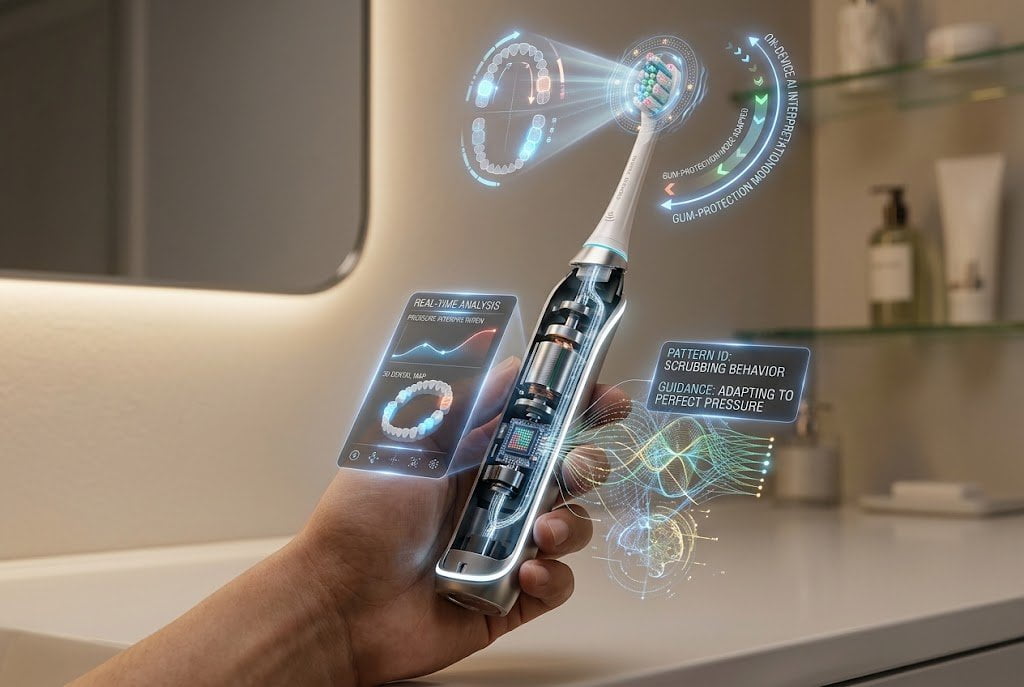
The next generation of smart sensors doesn't just detect pressure — it interprets brushing behavior, identifies patterns, and delivers real-time guidance without requiring users to open an app. This is where on-device AI becomes critical.
On-Device AI vs. App-Based Analysis
Bluetooth-connected toothbrushes typically send data to a smartphone app for analysis. The app tracks brushing time, coverage, and pressure — then shows you a report after you've finished.
I see a clear limitation here: feedback delivered after brushing is too late to change behavior during that session.
Philips' 2026 product announcements signal an industry shift. Their next-generation electric toothbrushes process sensor data directly on the device, using embedded AI to provide real-time haptic feedback, audio cues, or LED indicators during brushing.
Here's why this matters:
- Immediate behavior correction — users adjust technique in real time, not days later
- No smartphone dependency — guidance works even when the phone is in another room
- Better privacy — sensitive health data doesn't need to leave the device
For OEM/ODM teams, this means investing in more capable microcontrollers, optimized machine learning models, and tighter integration between sensors and control logic. It raises the technical bar, but it also creates genuine differentiation in a crowded market.
Multi-Sensor Fusion for Behavioral Understanding
Pressure sensors alone can't fully understand brushing behavior. The next generation combines:
- Force sensors for pressure detection
- Gyroscopes and accelerometers for motion tracking
- Timers for duration and coverage
- Microphones (in some designs) for audio-based plaque detection
When fused through AI algorithms, these sensors don't just collect data — they interpret intent. Did the user skip the inner molars? Are they brushing too quickly in one quadrant? Is pressure inconsistent across different zones?
This level of contextual awareness moves electric toothbrushes from passive tools to active coaching devices.
Personalization and Connectivity: From More Modes to a Smarter Oral Care Ecosystem?
I've noticed that many "smart" toothbrushes emphasize connectivity features — Bluetooth pairing, app integration, cloud data sync. But connectivity alone isn't personalization. True personalization means the device learns from your behavior and adapts without manual intervention.
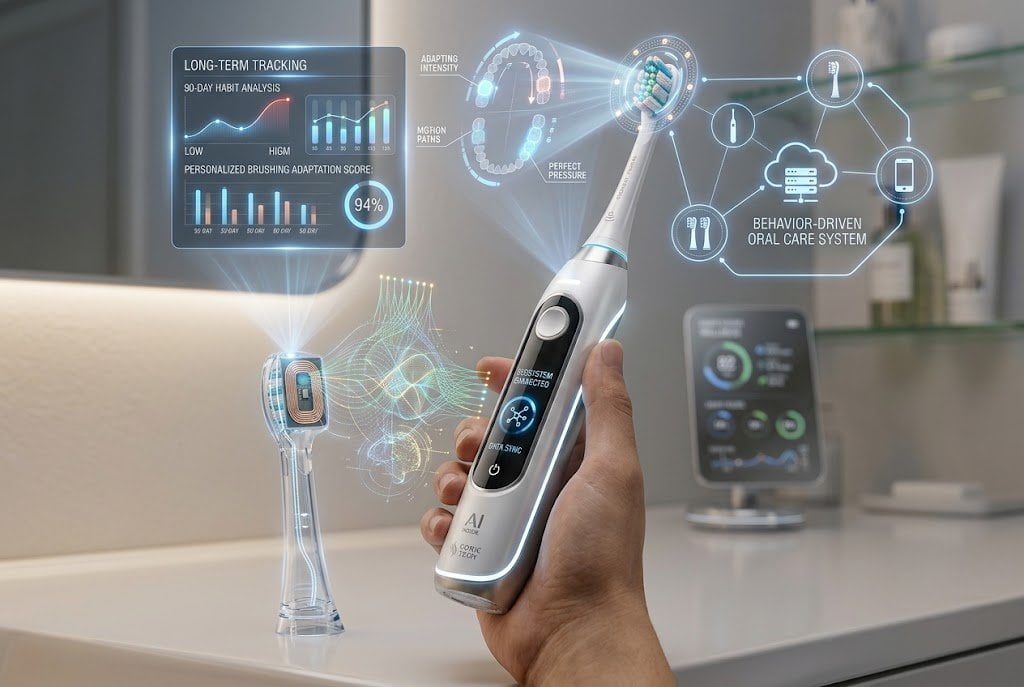
The next generation of electric toothbrushes will shift from user-selected modes to behavior-driven adaptation, creating a smarter oral care ecosystem where the brush, replacement heads, and long-term tracking work as an integrated system.
Behavioral Personalization Over Manual Mode Selection
Most electric toothbrushes offer multiple modes: Daily Clean, Sensitive, Gum Care, Whitening. Users choose one, and the brush runs at a fixed intensity. That's customization, not personalization.
Real personalization looks different:
- The brush detects that you apply more pressure on the right side and automatically reduces intensity there
- After two weeks of use, the device adjusts default cleaning time based on your average brushing duration
- When you switch brush heads (from standard to sensitive), the motor profile changes automatically
This requires persistent on-device learning — not just storing data, but refining behavior over time. For brands developing private-label products, this creates a clear competitive advantage: products that improve with use, not just maintain static performance.
Brush Head Management and Lifecycle Intelligence
Brush head replacement reminders aren't new. But I'm seeing them evolve from simple timers into lifecycle management systems.
Advanced electric toothbrushes in 2026 will:
- Track actual usage intensity, not just elapsed time
- Recognize which brush head type is installed (standard, sensitive, orthodontic)
- Adjust cleaning profiles based on head condition
- Integrate with subscription services for automatic reordering
This isn't just a convenience feature — it's a business model enabler. For distributors and e-commerce sellers, linking brush head management to recurring revenue creates long-term customer relationships beyond the initial product sale.
| Traditional Approach | Next-Generation Ecosystem |
|---|---|
| Generic 90-day timer | Usage-based replacement tracking |
| Manual reordering | Automated subscription integration |
| One-size-fits-all reminder | Head-specific performance monitoring |
From an OEM/ODM perspective, implementing this requires RFID or NFC chips in brush heads, cloud-based inventory systems, and partnerships with logistics providers. But it transforms the toothbrush from a standalone device into a platform.
Beyond Features: What Will Really Define the Next Generation of Electric Toothbrushes?
Here's where the industry conversation gets more nuanced. AI sensors, adaptive motors, Bluetooth connectivity — these technologies are rapidly becoming table stakes. Pressure sensors that once differentiated premium models now appear in mid-range products. Smartphone apps that were flagship features three years ago are now expected basics.
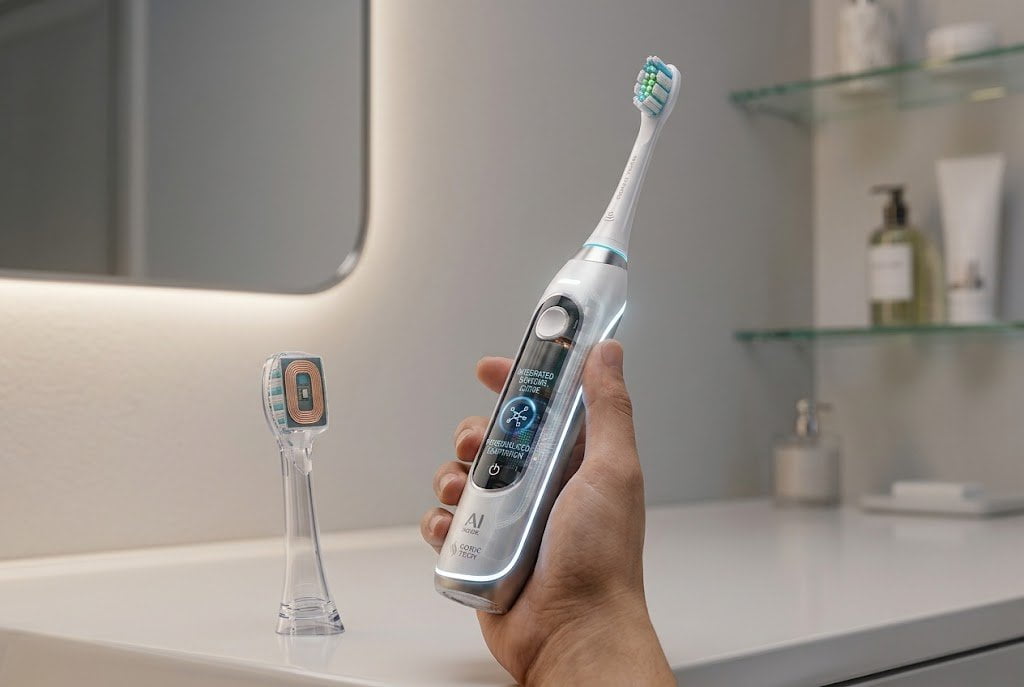
The real competitive question isn't whether your toothbrush has these technologies — it's how well they're integrated, how accurately they perform, and how simply they work from the user's perspective.
Integration Quality Over Feature Count
I've worked with procurement teams evaluating electric toothbrush suppliers. The conversation used to focus on spec sheets: vibration frequency, number of modes, battery capacity. Now, the questions are different:
- How accurate is the pressure sensor across different brush head types?
- Does the motor maintain consistent performance at low battery charge?
- How responsive is the real-time guidance system?
- What's the failure rate on the gyroscope after 12 months of use?
These aren't glamorous marketing points, but they determine whether advanced features actually work in daily use. A toothbrush with five sensors that deliver inconsistent data is worse than one with two sensors that are reliably calibrated.
For OEM/ODM partners, this means:
- Rigorous component qualification — not just testing individual sensors, but validating their performance as an integrated system
- Long-term reliability testing — AI algorithms need to perform accurately after hundreds of brushing sessions, not just in factory conditions
- Acoustic and vibration tuning — advanced motors should reduce noise, not increase it
Simplicity as a Design Principle
Here's a counterintuitive insight: the next generation of electric toothbrushes should require less user input, not more.
Early smart toothbrushes asked users to:
- Choose from multiple modes
- Open an app before brushing
- Review detailed reports after each session
- Manually track brush head replacement
- Adjust settings across multiple menus
That's not smart — that's complicated.
The best products I've seen in development reverse this trend:
- Single-button operation with automatic mode adjustment
- Visual indicators for guidance (no app required)
- Auto-pairing when the app is opened (not mandatory pairing for basic use)
- Default settings that adapt over time without user configuration
This approach requires sophisticated engineering — the simpler the interface, the more intelligence must happen behind the scenes. But it aligns with the broader principle: the future of oral care is not more technology, but less effort through better technology.
What This Means for Brands and Product Developers
If you're evaluating the next generation of electric toothbrushes for your brand or distribution channel, consider these strategic questions:
For brand managers:
- Does your product roadmap prioritize adaptive intelligence over feature lists?
- Can your target users articulate the difference between your toothbrush and competitors?
- Are your marketing claims backed by measurable performance improvements?
For procurement and product teams:
- Do your supplier partners demonstrate expertise in sensor fusion and motor control algorithms?
- Can they provide long-term reliability data for advanced features?
- Is their R&D focused on integration quality, not just component sourcing?
For e-commerce and retail distributors:
- Does your toothbrush ecosystem support subscription models for replacement heads?
- Can customers experience the value of smart features without requiring extensive setup?
- Are warranty and support systems prepared for more complex electronic products?
In our experience working with global brands and distributors, the OEM/ODM partners who succeed in the next generation aren't just manufacturing products — they're solving integration challenges, validating performance under real-world conditions, and supporting brands through regulatory and quality management complexity.
Frequently Asked Questions
What makes a toothbrush "next generation" in 2026?
Next-generation electric toothbrushes prioritize adaptive cleaning over raw power, integrate on-device AI for real-time guidance, and personalize performance based on user behavior rather than requiring manual mode selection. The defining characteristic is intelligent integration, not feature count.
Will AI electric toothbrushes require a smartphone to function?
The best AI-powered toothbrushes in 2026 will deliver core guidance features without smartphone dependency. On-device processing enables real-time feedback through haptic cues, LED indicators, or audio signals. Smartphone connectivity becomes optional for deeper analytics, not mandatory for basic intelligent operation.
How do OEM/ODM partners support brands developing smart toothbrushes?
Professional OEM/ODM manufacturers provide end-to-end support including sensor integration, motor control algorithm development, regulatory compliance (FDA 510k, CE, FCC), multi-level quality testing, and customized packaging. Full-cycle development services ensure smart features perform reliably across production volumes while meeting international certification standards.
Are pressure sensors and motion tracking standard features now?
Pressure sensors are becoming standard across mid-to-premium ranges. Motion tracking and multi-sensor fusion remain differentiators in premium segments but are rapidly moving downstream. By 2026, the competitive focus will shift from having these sensors to how accurately and intelligently they're implemented.
What should procurement teams prioritize when evaluating smart toothbrush suppliers?
Focus on sensor accuracy and long-term reliability, motor control consistency under varying conditions, integration quality across hardware and software, regulatory compliance documentation, and the supplier's R&D capabilities in adaptive algorithms. Request performance data from extended testing, not just initial specifications.
Conclusion
The next generation of electric toothbrushes represents a fundamental shift from hardware specifications to behavioral intelligence. Adaptive sonic motors, on-device AI, and integrated sensor systems are transforming how users experience daily oral care — making brushing more effective with less conscious effort.
For brands, distributors, and product developers, this evolution requires strategic focus on integration quality, user simplicity, and ecosystem thinking. The most successful products won't be those with the longest feature lists, but those that deliver smarter, more responsive cleaning through better engineering.
As a manufacturer supporting global oral care brands, we've observed this transition firsthand: procurement conversations now center on algorithm performance, sensor reliability, and lifecycle management capabilities. The technology is no longer just about vibration frequency or battery capacity — it's about creating products that learn, adapt, and improve with use.
The next generation of electric toothbrushes will not win by adding more features. They will win by making everyday brushing smarter, simpler and more responsive.
If you're developing oral care products for 2026 and beyond, we'd welcome the conversation. Reach out to explore how adaptive technology, intelligent sensors, and full-cycle OEM/ODM support can position your brand at the forefront of this industry transformation.
Contact us: amyli@xijunsong.com | +86 0757 2229 6906