Struggling to differentiate in a saturated toothbrush market1? Adding features feels like a gamble. A strategic focus on verifiable efficacy can de-risk your next product launch and create real value.
To successfully leverage LED light therapy, your focus must shift from the feature itself to a rigorous procurement framework. Evaluate suppliers on verifiable efficacy, manufacturing maturity, and their ability to support your brand’s defensible marketing2 claims. This approach mitigates risk and ensures a successful product.
As a market analyst, I've seen countless brands get stuck in a feature war. They chase the latest trend without a clear strategy for validating its worth. This often leads to products that underdeliver and damage brand trust. The conversation around oral care is changing, moving beyond simple cleaning specs. To win, you must understand this shift and equip yourself with the right questions to ask your manufacturing partners. It's time to move from marketing claims to a procurement strategy based on evidence and integration.
The End of the "Vibration Frequency Arms Race": Why is Efficacy Care Becoming the New Demand?
Competing on vibration speed has hit a wall. Consumers are becoming numb to these escalating numbers. The solution is to shift the conversation to "efficacy care," offering a new, meaningful benefit.
Efficacy care meets a rising consumer demand for tangible health benefits that go beyond basic cleaning. It moves the discussion from mechanical specs, like vibrations per minute, to proven outcomes, creating a stronger value proposition.
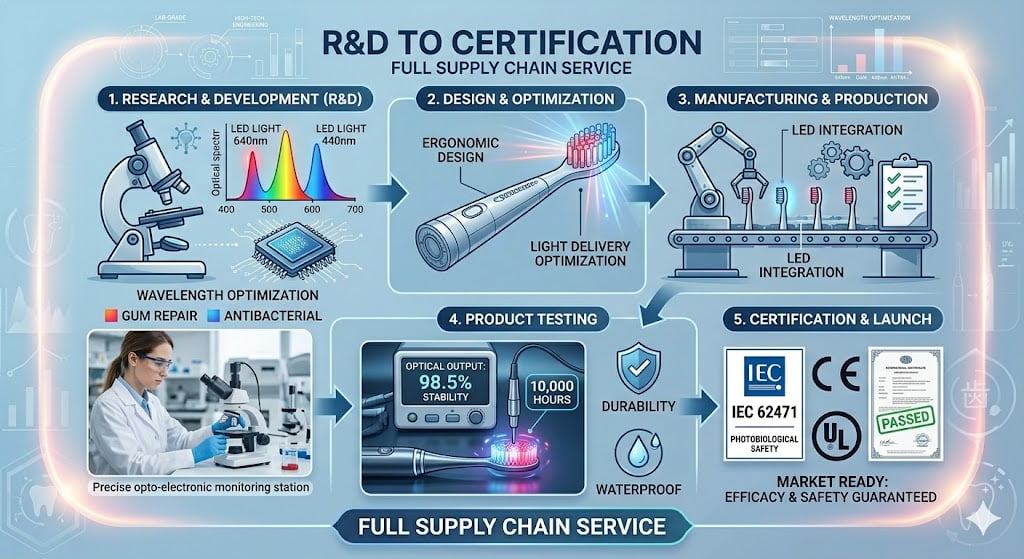
For years, the electric toothbrush market has been defined by a simple metric: vibrations per minute. From our analysis of the market, this "arms race" is reaching its natural conclusion. Brands are hitting the physical and practical limits of motor speed, and more importantly, consumers are struggling to see the difference between 40,000 and 60,000 vibrations. This is where the strategic narrative of "efficacy-based care" comes in. It reframes the product's value proposition entirely.
The Rise of Health-Conscious Consumers
Today's buyers are more informed and health-focused than ever before. They don't just want a tool that cleans; they want a solution that contributes to their overall oral health. They're interested in benefits like gum care, whitening, and reducing sensitivity. This creates an opening for products that can deliver and, crucially, prove these advanced benefits.
Shifting the Value Conversation
Instead of talking about a faster motor, efficacy-based care allows you to talk about healthier gums or a brighter smile. This shift is powerful. It elevates the product from a simple commodity to a personal care device. However, this shift comes with a major responsibility for you as a product or brand manager. You cannot simply adopt the marketing language; you must be prepared to back it up with solid proof from your supply chain. The demand is real, but so is the risk if claims are unsubstantiated.
LED Light Therapy: Is It the Core Technology to Realize "Efficacy-Based Care"?
You see LED light therapy as a promising technology. But you are rightly concerned that it could just be a marketing gimmick. The key is to understand how to validate its role.
Yes, LED light can be a core technology for efficacy, but only if it is implemented correctly. Its value depends entirely on a supplier who provides verifiable technical specs, robust product integration, and credible evidence.
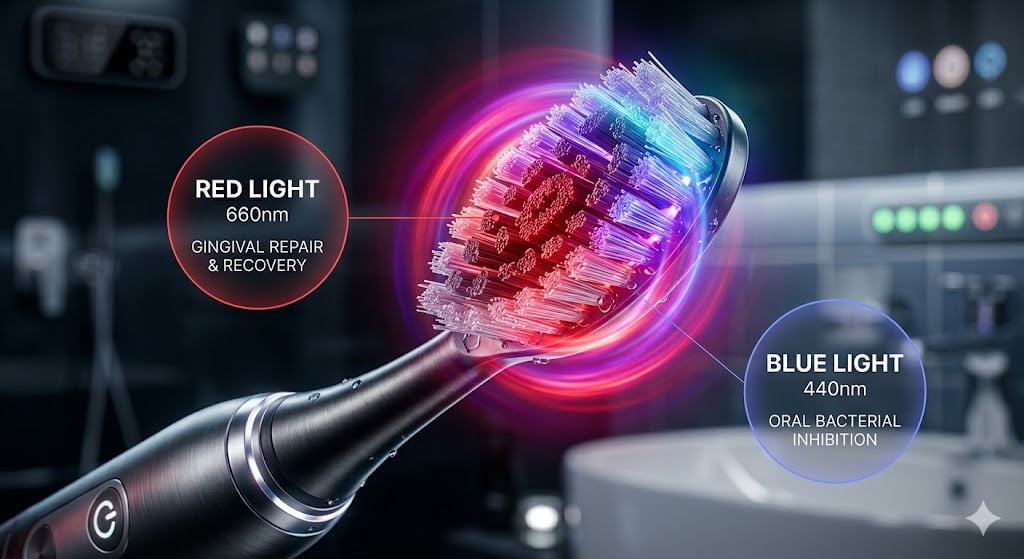
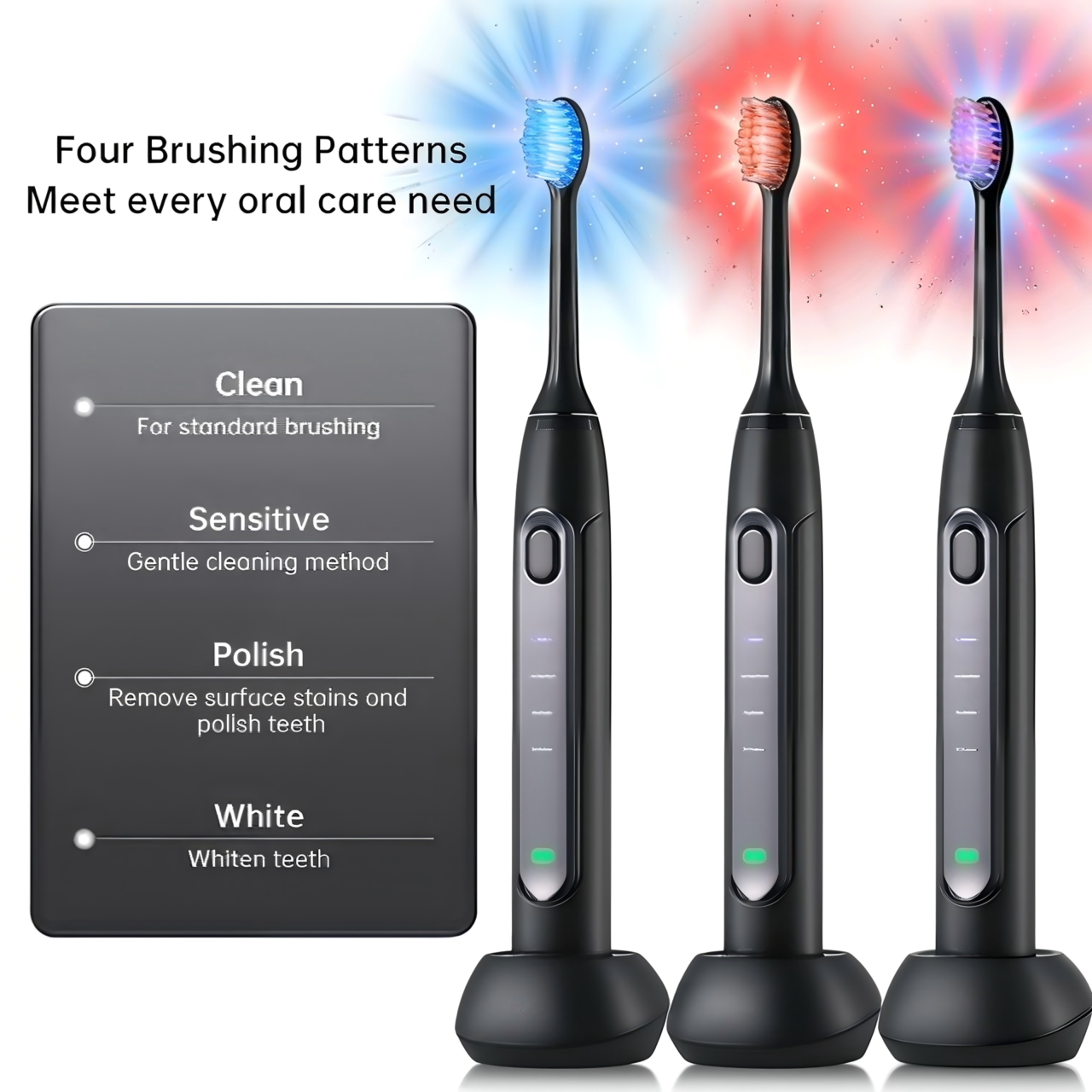
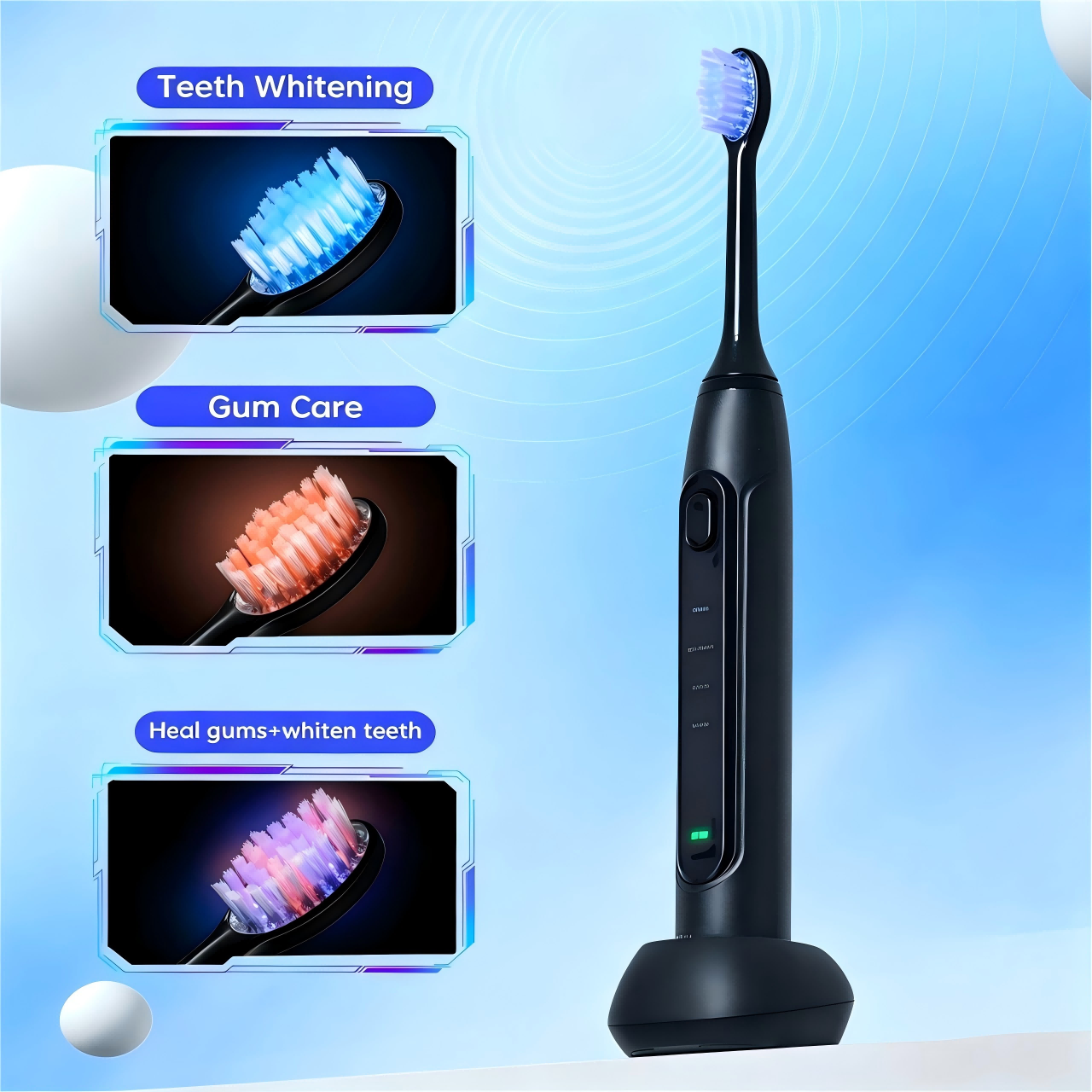
LED light therapy is the leading technology driving this new category of efficacy care. But from my experience observing product development cycles, product managers often overlook the critical details. Adding a blue or red light is easy; adding a light that delivers a verifiable, consistent, and safe therapeutic effect is not. The feature's potential is only realized through rigorous supplier vetting. A mature product integrates this technology without compromising the toothbrush's core functions. Your job is to assess the total integration, not just the isolated feature. The critical questions you ask your potential OEM/ODM partner will determine your success.
Key Questions for Your OEM/ODM Partner
Here is a framework I recommend for evaluating any potential partner for an LED toothbrush project.
| Category | Key Question to Ask Your Supplier | Why It Matters |
|---|---|---|
| Efficacy & Safety | What specific wavelength (in nm) and power density (in mW/cm²) does the LED emit? Can you provide third-party data? | Different wavelengths target different outcomes (e.g., blue for whitening, red for inflammation3). Without specific data, "care" is just a marketing term. |
| Regulatory Compliance | Does the device have regulatory clearance or certification (e.g., FDA, CE Medical Device) for its claims? | This is non-negotiable for making health-related claims in many markets. It's a key indicator of supplier maturity and de-risks your market entry. |
| Product Integration | How does the LED feature impact battery life, charging time, and overall product longevity? | A poorly integrated feature can create a negative user experience. The device must still perform as an excellent toothbrush first and foremost. |
| Manufacturing & QC | What is your quality control process for ensuring consistent LED output and reliability across a mass production batch? | Inconsistent output means some customers get the benefit, and others don't. This creates brand risk. Ask about their testing protocols for LED components. |
| Design & Usability | How does the LED integration affect the brush head design, cost, and replacement cycle? Is the device still fully waterproof (IPX7/8)? | The feature should not make the product difficult to use or expensive to maintain. Practicality is essential for long-term customer satisfaction. |
Brand Value Upgrade: How Can You Seize the LED Light Therapy Market Dividend?
You want to enter the promising LED toothbrush market. But you know a poorly executed product could damage your brand's reputation. You can seize the dividend by choosing a partner who helps you build credibility.
Seize the market dividend by partnering with an OEM/ODM that provides a solid foundation for defensible marketing. This means leveraging their technical data, certifications, and quality control to build a trustworthy story for your customers.
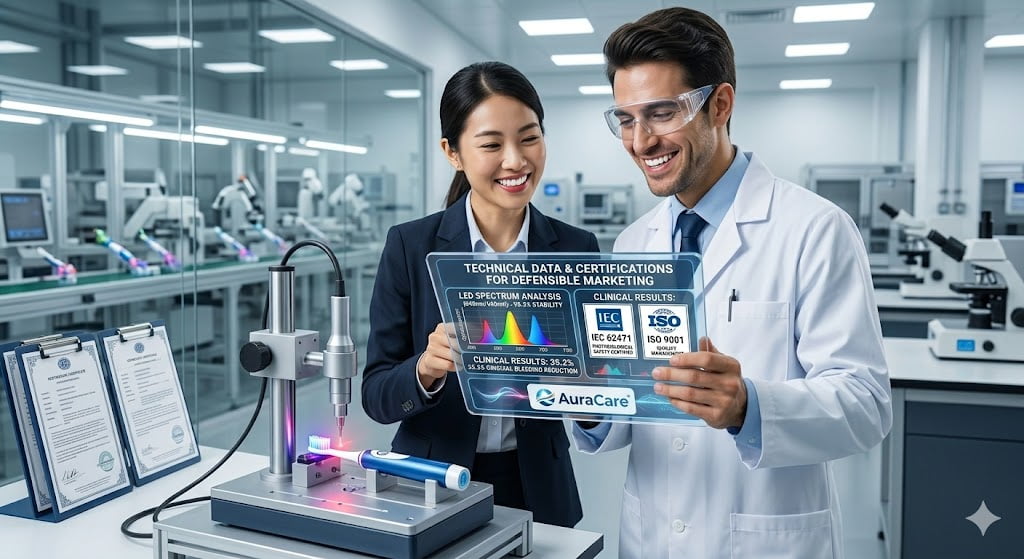
The real value of adding a feature like LED light therapy is not the feature itself, but the defensible claims it allows your brand to make. Product managers we've observed often get caught up in the technology, but the true business opportunity lies in building a credible brand narrative. Your choice of a manufacturing partner is therefore a strategic brand decision. A great partner doesn't just give you a product; they give you the evidence you need to build consumer trust and protect your brand's reputation for the long term.
Building a Credible Narrative
Your marketing team can't invent claims. They need ammunition. A good supplier provides this by sharing technical specifications, clinical data, and certifications. This allows you to build a marketing story based on "our toothbrush is clinically proven to..." rather than "our toothbrush has a blue light." This distinction is the difference between a fleeting trend and a sustainable product category.
Differentiating in a Crowded Market
As more brands launch LED toothbrushes, the market will become noisy. Your brand will stand out not by having the feature, but by being the most trustworthy source. You can achieve this by being transparent with the evidence your supplier provides. This turns the technical due diligence you perform during procurement into a powerful marketing asset that your competitors, who chose less mature suppliers, cannot replicate. This is how you win.
Future Outlook: Will Efficacy Care Become the Core of the Electric Toothbrush Market?
You need to plan your product roadmap for the next three to five years. You're wondering if this "efficacy" trend has staying power or if it is just a passing fad.
Our analysis suggests yes, this trend is here to stay. As consumers become more health-savvy, their expectations will permanently shift from basic cleaning to products with proven health benefits. Brands that build a foundation in verifiable efficacy will lead.
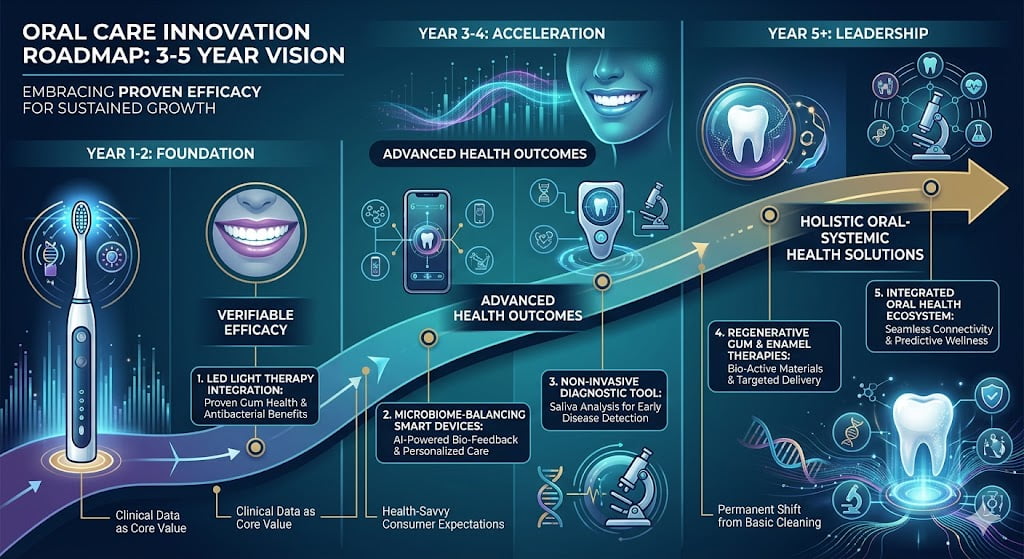
Based on our analysis of consumer trends and technological advancements, the shift toward efficacy-based care is not temporary. It represents a fundamental evolution of the oral care market. LED light therapy is the first wave, but the underlying principle—delivering and proving health outcomes—will become the new standard. As a brand or product manager, preparing for this future means developing a sourcing framework that prioritizes evidence over claims. This capability will become your most significant competitive advantage.
Beyond LED: The Next Wave of Efficacy
While LED light is the current focus, we are already seeing the early stages of other efficacy-based technologies. This includes things like pressure sensors that do more than just warn you, but actually guide your technique4 for better gum health, or ion technology aimed at plaque reduction5. The specific technology will change, but the consumer demand for proven results will only grow stronger.
The Importance of a Strategic Sourcing Framework
The key takeaway for your long-term strategy is this: the process you build today to validate an LED toothbrush supplier is the same process you will use to validate the next generation of efficacy-based products. Focusing on evidence, integration, and supplier maturity is a future-proof strategy. It moves your team from being reactive to market trends to proactively building categories based on proven, reliable technology. Brands that master this will not just participate in the future of oral care; they will define it.
Conclusion
Evaluating LED toothbrushes requires a procurement framework focused on verifiable efficacy and supplier maturity, not just features. This approach de-risks your investment and builds lasting brand value.
"Oral Care Market Size, Share, Trends, Forecast Report, 2034", https://www.fortunebusinessinsights.com/oral-care-market-103533. Market research reports can provide statistics on the size, competitive density, and modest growth rates of the global oral care market, which are indicators often associated with market saturation. Evidence role: statistic; source type: research. Supports: The source should provide data on the global toothbrush market, including its size, growth projections, and competitive landscape.. ↩
"FTC Policy Statement Regarding Advertising Substantiation", https://www.ftc.gov/legal-library/browse/ftc-policy-statement-regarding-advertising-substantiation. In the United States, the Federal Trade Commission (FTC) requires that advertisers have a 'reasonable basis' for all objective product claims before they are disseminated, with specific substantiation standards for health and safety claims. Evidence role: general_support; source type: government. Supports: The source should explain the legal requirement for advertisers to have proof for their claims.. ↩
"A Review of Photobiomodulation in Dental Practice - PubMed", https://pubmed.ncbi.nlm.nih.gov/40928982/. Scientific literature on photobiomodulation in dentistry explores the use of blue light as an activator for bleaching agents in teeth whitening and red or near-infrared light for its potential anti-inflammatory effects on gingival tissue. Evidence role: mechanism; source type: paper. Supports: The source should be a scientific paper explaining the mechanisms and evidence for using specific light wavelengths for dental applications.. Scope note: The evidence for efficacy can be varied and may depend on specific parameters like wavelength, power density, and duration of exposure. ↩
"Intelligent Brushing Monitoring Using a Smart Toothbrush with ...", https://pmc.ncbi.nlm.nih.gov/articles/PMC7916355/. Some modern electric toothbrushes incorporate advanced sensors and AI to provide real-time feedback, using lights or app-based visuals to guide users on applying optimal pressure and achieving better coverage, moving beyond simple warning alerts. Evidence role: case_reference; source type: other. Supports: The source should describe the functionality of an existing smart toothbrush that uses sensors to provide real-time feedback on brushing technique.. Scope note: The effectiveness of this guidance in improving long-term oral health outcomes would require separate clinical validation. ↩
"Clinical comparison of an electric-powered ionic toothbrush and a ...", https://pubmed.ncbi.nlm.nih.gov/33029896/. Clinical studies have investigated the efficacy of ionic toothbrushes, which work on the principle of changing the polarity of the tooth surface to repel plaque. A systematic review of these studies can provide an overview of the evidence for their effectiveness compared to conventional toothbrushes. Evidence role: mechanism; source type: paper. Supports: The source should be a scientific paper that explains how ionic technology is purported to work for plaque reduction and what the clinical evidence shows.. Scope note: The body of evidence may be limited, and results across studies can be inconsistent. ↩